New St Mary's church
By the 1840s the Old Church was unable to house the increased size of the congregation despite several attempts to accommodate more people by installing galleries and extra seating in the chancel. The population had increased from 706 in 1801 to 1066 in 1841.
John Mendham was the assistant Curate who succeeded as Rector on the death of William Pierce Nethersole in 1844. His solution to the problem was to build a new church.
Many meetings were held and at one the Earl de Grey, Patron to the church and chairman, promised "the stone and £200 besides" and promised to consult "Mr Smith". Thomas Smith of Hertford, was an architect and protégé of the Earl. The Earl, Thomas Philip, was the first president of Royal Institute of British Architects and was a keen amateur architect.
Rev. J. Mendham and Mrs. Mendham put forward £500. £600 came from other people and £700 was to be borrowed from the Public Works Loan office.
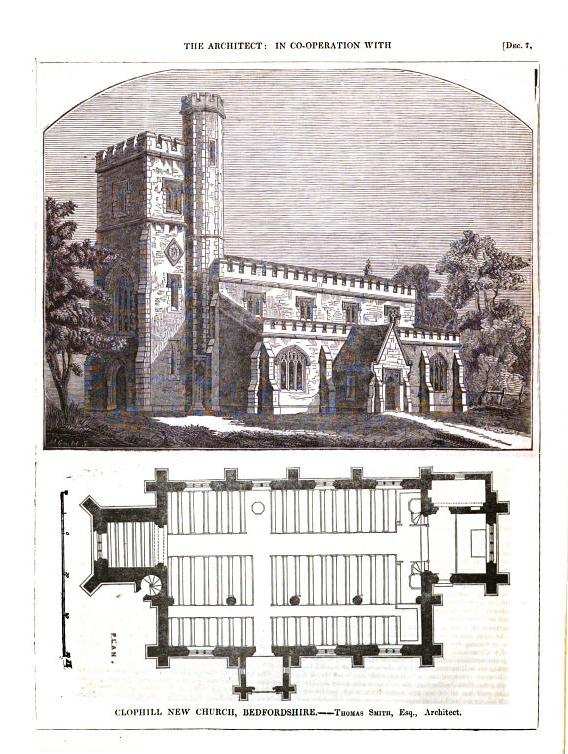 Plan of new church
The new church was to be built on a plot of land opposite the Rectory in the High Street. It consisted of a nave with a southern aisle, a tower, a small chancel and a south porch.
The first stone was laid on 19th June 1848 and the finished church was consecrated on 10th July 1849.
It was built in the Gothic style and described by Nikolaus Pevsner as "an archaeologically convincing job, i.e. a church which the casual visitor might regard as genuine.
By 1879 the church was already in need of repair and was closed for a time.
In 1964 dry rot was discovered and an extensive scheme of works over the next five years, included re-roofing, was carried out. Services were held in the Parish Room but it unfortunately burnt down and the school was used.
Link to 175th anniversary exhibition.
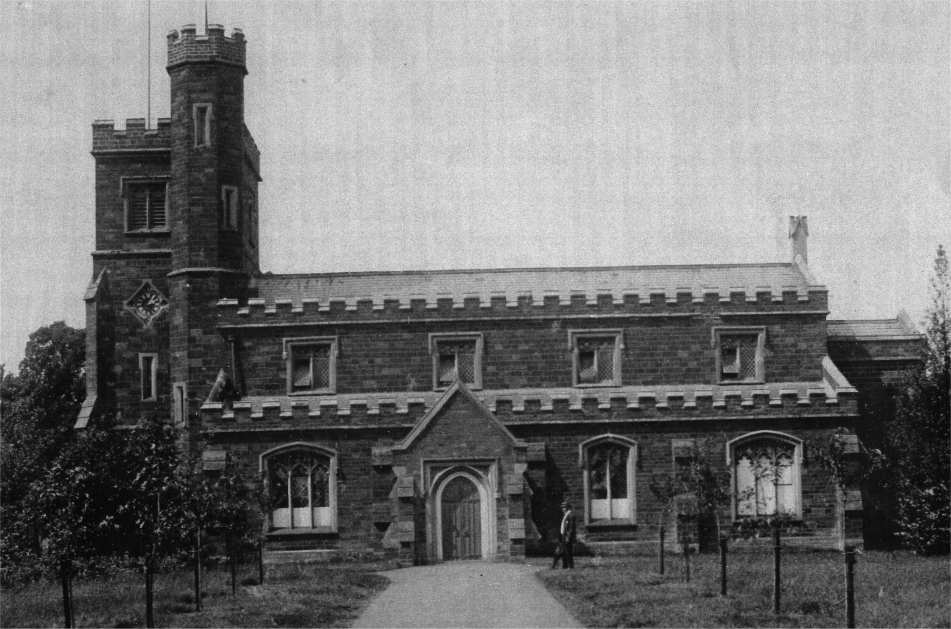 The church as built
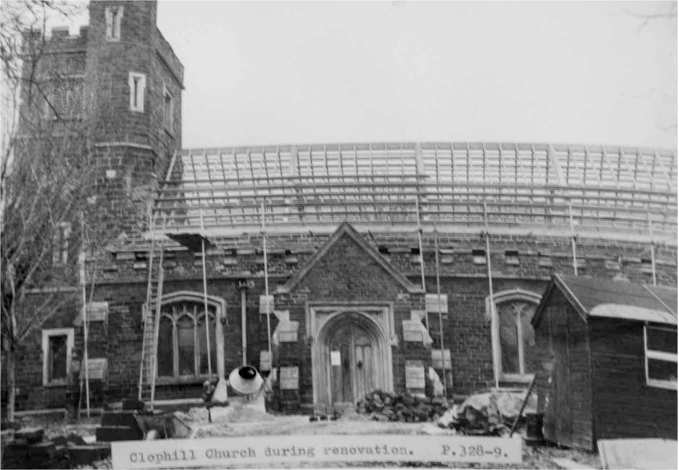 The church being reroofed
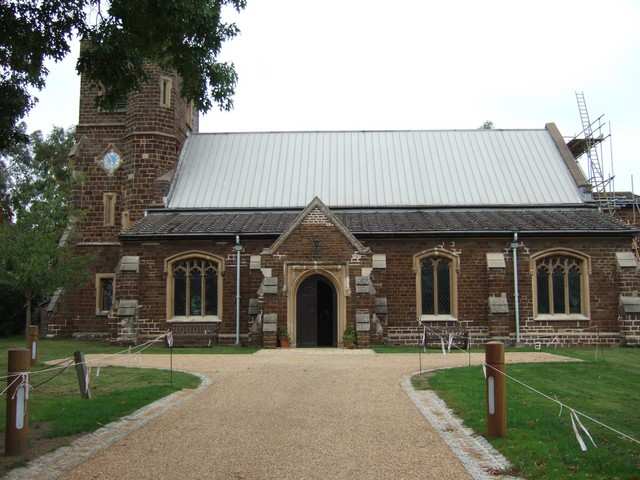 The church now
The Church Interior
Taken from the Church website.
The Organ
THE ORGAN was built by J and A Trustram of Bedford in 1892.
It was originally sited in the south aisle, where it remained until 1968, when it was moved to the west end of the church.
In 1996 it was moved to the north wall, then in 2003 it was completely rebuilt by Vincent Woodstock on the restored gallery floor.
The Pulpit
THE PULPIT was built by John Stevens at a cost of £20.
An early ground plan shows it to have been at the north side of the chancel arch.
It was subsequently moved across to the south side, then in 1957 to part way up the church.
It was returned to its former position in 1996 for acoustic reasons.
The Font
THE FONT is believed to have come from the Old Church and has also been “peripatetic”, coming to its current position in 2003.
The Brass Lectern
THE BRASS LECTERN was given to the church in 1886 “in loving memory of our most self-denying parents” by the offspring of F and C Horn.
On the reading desk plate, there is a circular inscription with the letters IHS in a decorative script.
This is a very common Christogram, derived from the first three letters of “ΙΗΣΟΥΣ” (Jesus) in Greek, and widely used in Victorian church fittings.
The Clock
THE CLOCK bears the date 1849, but was installed in 1853 at a cost of £50, raised by public subscription.
The Three Bells
THE THREE BELLS were originally in the Old Church.
They are fixed, rather than “swung” which means that they can be rung by only one ringer.
The Heads
THE HEADS supporting the beams are interesting, because they are made of Pulhamite, a form of moulded concrete invented in the early 19th century by James Pulham of Hoddesdon, and much used by Thomas Smith in his churches. There are much more naïve versions in Silsoe Church.
The Pictures
THE PICTURES on the staircase wall show the Old Church in 1844. They were painted by Lewis Allen, who was staying at Wrest Park with Earl de Grey. The one of the interior clearly shows the carved beam now in St. Alban’s Chapel.
The Clophill Doll
THE CLOPHILL DOLL is dressed in the style of the Sunday School girls of the 1840s. It was given to the church by a Miss Kingsley early in the 20th century.
