Insight into society
The Domesday Book reveals an elaborate feudal structure of landholding from the King down.
Under the feudal system the King stood at the top of the feudal ladder and all land was held from him, either directly or indirectly. The King granted parcels of land called fiefs to the tenants-in-chief beneath him - his chief barons, bishops and abbots. This was partly as a reward for helping him to conquer the kingdom, partly to keep their loyalty, and partly to ensure that certain difficult geographical areas were being securely held for him. In return he received their loyalty and service.
This service usually came in the form of supplying the King with a number of men-at-arms and Knights for a specific period should he wish to raise an army.
In turn the barons could parcel out the land given to them to their own sub-tenants who likewise owed them loyalty and service – again usually military.
Domesday is thus more than a legal and fiscal document. It is also a record of the new feudal system of landholding imposed by William on his new kingdom.
Apart from the feudal structure Domesday also gives the:
- Names of landholders in each county
- Manors which they held and their values
- Names of their sub-tenants
- Names of many boroughs and details of their customs
- Number of freemen, sokemen, unfree peasants and slaves on each manor
- Resources of each manor
The inconsistencies and omissions within Domesday, coupled with our own imprecise understanding of the meanings of some of the terms it uses, mean that it is very difficult to use the information within it for precise statistical analysis.
Quoted from National Archives website
Clophill

Entry in Domesday Book for Clophill.
Translation
Nigel himself holds Clophill.
Nigel d'Albini, tenant-in-chief, i.e. he held his lands under direct tenure from the king.
It is assessed at 5 hides.
The hide was the standard unit to tax, especially geld. Notionally the amount of land which would support a household.
There is land for 8 ploughs.
One way of assessing the value of an estate was to estimate the number of eight-ox plough teams needed to cultivate the land.
Thus, a Domesday entry might say a 'There is land for 6 ploughs.', meaning that there was enough land on the estate to require 6 ox teams to work it.
In demesne [are] 3 hides, and there are 2 ploughs; and 5 villans have 6 ploughs.
Demesne means land in 'Lordship' whose produce was devoted to the Lord rather than his tenant.
A Villan was a peasant of higher economic status than a bordar and living in a village. Notionally unfree because subject to the manoral court.
There are 5 bordars and 1 slaves, meadow for 4 ploughs, [and] woodland for 200 pigs and [rendering] 12d.
A bordar was a cottager: a peasant of lower economic status than a villan.
Slaves were at the bottom of the economic and social scale, normally without resources of their own and there to perform their lord's bidding.
It is worth 60s; when received. 30s; TRE £8.
Worth meant the value at the time of the survey (1086).
When received was the value at the time when the estate passed to its new holder.
TRE meant Tempore Regis Edwardii. In the time of King Edward. The value at the date of his death, 5 January 1066.
2 thegns, men of Earl Tosti, held this manor.
A thegn was a man of noble status as opposed to a peasant.
Earl Tosti was the brother of King Harold. Killed at Stamford Bridge in September 1066.
A manor was an estate. Manors could be vastly different in size, and might have an official lord's residence, or castle, at its centre.
Of these 5 hides Nigel himself claims 1 virgates which his predecessor held TRE.
A virgate was a quarter of a hide.
Nigel himself was seised of it after he came into [possession of] the honour, but Ralph Taillebois disseised him.
The phrase 'to be seised of' means 'to possess' or 'to be in possesion of'.
Ralph Taillebois was probably a Norman knight. Later Sheriff of Bedfordshire.
Cainhoe 1
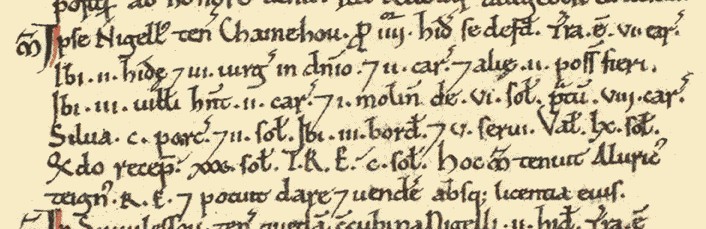
First entry in Domesday Book for Cainhoe.
Translation
Nigel himself holds Cainhoe.
Nigel d'Albini, tenant-in-chief, i.e. he held his lands under direct tenure from the king.
It is assessed at 4 hides.
The hide was the standard unit to tax, especially geld. Notionally the amount of land which would support a household.
There is land for 6 ploughs.
One way of assessing the value of an estate was to estimate the number of eight-ox plough teams needed to cultivate the land.
There are 2 hides and 3 virgates in demesne, and 2 ploughs, and there can be 2 others.
Demesne means land in 'Lordship' whose produce was devoted to the Lord rather than his tenant. A virgate is a quarter of a hide.
There 3 villans have 2 ploughs, and [there is] 1 mill rendering 6s, meadow for 8 ploughs, [and] woodland for 100 pigs and [rendering] 2s.
A villan was a peasant of higher economic status than a bordar and living in a village. Notionally unfree because subject to the manoral court.
There are 3 bordars and 5 slaves.
A bordar was a cottager: a peasant of lower economic status than a villan.
Slaves were at the bottom of the economic and social scale, normally without resources of their own and there to perform their lord's bidding.
It is worth 60s; when received, 30s; TRE 100s.
Worth meant the value at the time of the survey (1086).
When received was the value at the time when the estate passed to its new holder.
TRE meant Tempore Regis Edwardii. In the time of King Edward. The value at the date of his death, 5 January 1066.
Ælfric, a thegn of King Edward, held this manor and could give and sell it without his leave.
Ælfric was one of the wealthiest of the East Anglian thegns.
Edward the Confessor (1003 to 4th or 5th January 1066), son of Æhelred the Unready and Emma of Normandy, was one of the last Anglo-Saxon kings of England and is usually regarded as the last king of the House of Wessex, ruling from 1042 to 1066.
Cainhoe 2
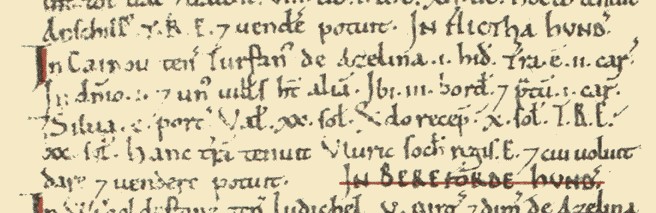
Second entry in Domesday Book for Cainhoe.
Translation
In Cainhoe Turstin holds 1 hide of Azelina.
Azelina was the wife of Ralph Tallboys, and was tenant-in-chief of part of Cainhoe. She sub-let it to Turstin who was a companion of William the Conqueror at the Battle of Hastings.
There is land for 2 ploughs. In demesne [is] 1 [plough]; and 1 villan has another.
One way of assessing the value of an estate was to estimate the number of eight-ox plough teams needed to cultivate the land. Demesne means land in 'Lordship' whose produce was devoted to the Lord rather than his tenant. A villan was a peasant of higher economic status than a bordar and living in a village.
There are 3 bordars, and meadow for 1 plough, and woodland for 100 pigs.
A bordar was a cottager: a peasant of lower economic status than a villan.
It is worth 20s; when received, 10s; TRE 20s.
Worth meant the value at the time of the survey (1086).
When received was the value at the time when the estate passed to its new holder.
TRE meant Tempore Regis Edwardii. In the time of King Edward. The value at the date of his death, 5 January 1066.
Wulfric, a sokeman of King Edward, held this land and could give and sell it to whom he wished."
Wulfric was landowner and was associated with 188 places before the Conquest; 29 after the Conquest.
A sokeman belonged to a class of tenants, found chiefly in the eastern counties, occupying an intermediate position between the free tenants and the bond tenants or villans.
Meaning
Although we are fortunate to have the surviving Doomesday Books, they do not come with an explaination of their meaning.
The area of a hide is thought to be about 30 acres.
The reference to ploughs could mean the area of land that could be ploughed by six oxen and a plough.
The number of pigs that woodland could support is another measure of area.
