Bread
Bread has long been a staple part of our diet. The Egyptians were baking bread with yeast as far back as 2500 years ago. And long before that people discovered how to grind grain into flour using quern stones that they turned by hand.
Mills
The first powered mills for grinding grain appeared in Britain shortly after the Romans arrived in AD 43. They were powered by either animals or water. The earliest reference to windmills was in the 1180s.
Doomsday Book
Doomsday Book (1086) records that there was a mill at Cainhoe, probably somewhere near the castle. It is also recorded that a mill existed at Beadlow in 1140, probably attached to Beaulieu Priory.
The main river passes under the A6 and A507 roads and then under the new bridge by The Green. You can see how much the river level has been raised as there is a drainage ditch which passes under the river in a tunnel.
If you view the area from the footbridge over the A507 you can see that the banks of the river have been raised above the field level.
There is a second weir which takes off some of the excess water.
Further along, the dashed line shows the original course of the river. It has been diverted to the mill along a new channel that has been built up to form the millstream or leat.
A sluice gate controls the flow of water to the mill by diverting excess flow in times of high rainfall. By the time the millstream has reached the mill it is about eight feet higher than the original stream. This difference in height is used to drive the mill wheel.
Clophill Watermill
The watermill at Clophill stands on the corner of the High Street and The Causeway. It was probably built in the eighteenth century. It is shown on a map of 1716.
Clophill Mill was used up until the early 20th century. The last miller was George Course who lived in the Mill House, now demolished. By then most flour for bread was produced by a new technique where the grain was crushed between metal rollers and stone-ground flour went out of fashion. Clophill Mill, in the late 19th and early 20th century probably ground grain for animal meal.
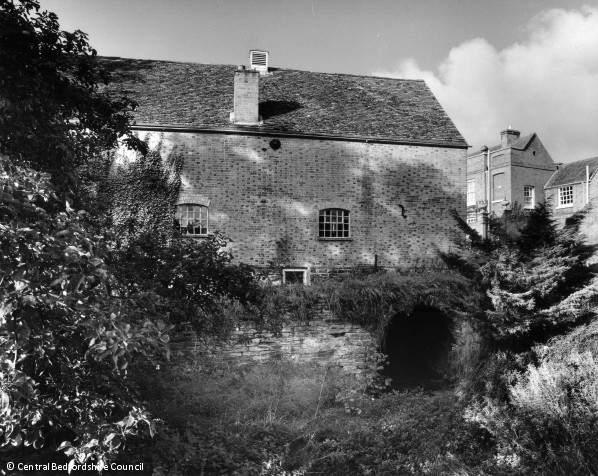 Clophill Watermill from The Causeway showing the tunnel that housed the waterwheel.
Machinery
The photographs below are arranged in spacial order but the sequence of motion transmission starts at the bottom and works its way up so it is probably best to start reading from the lowest paragraph. They were taken after most of the machinery had been removed leaving the basic mechanism. Unfortunately, all the machinery has now gone and the mill is a private residence.
The Rating and Valuation Act 1925
The watermill was assessed in 1927 under the The Rating and Valuation Act 1925 and was described as follows:-
It was constructed of brick and tile and had three floors with a loft and comprised:
- lower floor: the wheel itself, 10ft by 10ft and a sacking room;
- ground floor: three pairs of stones of 4' 6" diameter; an office; a cakestore and cake breaker;
- first floor: a flour dressing machine; a kibbler (for grinding); a smutter (for cleaning the grain); a corn store;
- loft: grain shutes and a store
Clophill Windmill
The Victoria County History, that was written between 1904 and 1918, records:- "... to the west of the village, at a short distance from the main road, stands an ancient windmill built of timber; the shape is peculiar, for the body is built like an ordinary barn with gables at the end. The mill sails used to be supported on large cross-beams which are attached to a square wooden turret with a low-pointed roof, which projects from the roof of the barn at the west end."
It is shown on a map of 1890 and was where Moore's Close is today (technically, in Maulden but this end of Maulden seems to have always associated itself with Clophill).
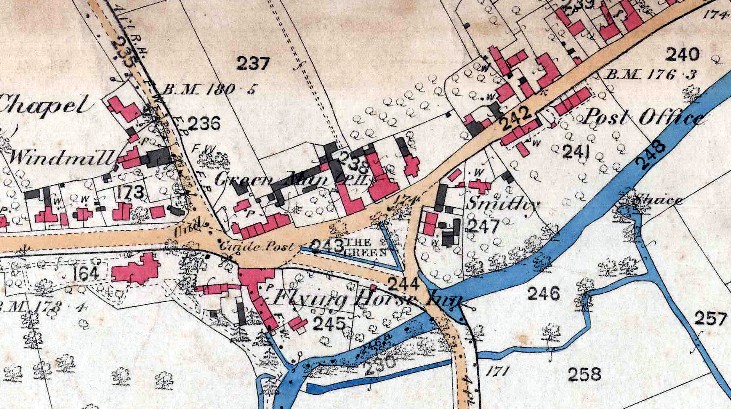 Clophill windmill
Millwrights
In the Hertford Mercury and Reformer of 14th July 1855 there was an advertisement for:-
"SEASONED OAK, ASH, ELM, LIME, and HORNBEAM TIMBER, TREES, PLANKS, Boards, Cross-trees. Posts and Scantlings, Mill Gears and Patterns, Hand Corn Mill, pair of new FRENCH MILLSTONES, Farming Implements, and other effects;"
"TO BE SOLD BY AUCTION, BY T. & G. GREENE, ON THE PREMISES, CLOPHILL MILL, On WEDNESDAY, 18th of July, 1855, at Ten o'clock In the forenoon, By direction of the Executors of the late Mr. J. Burroughs,"
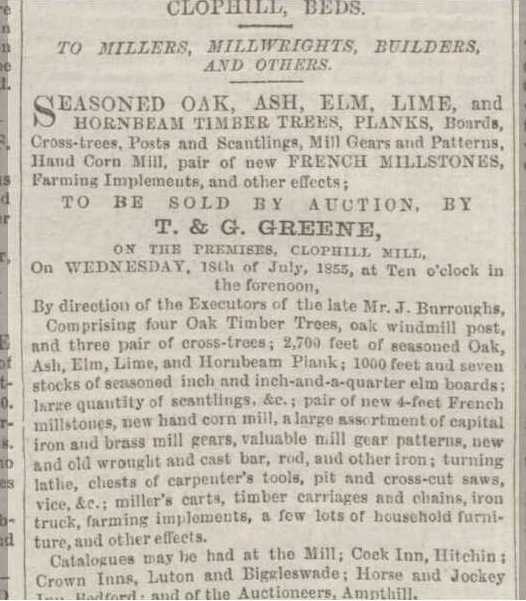
This would indicate that there was a millwrights business carried on at the mill at Clophill.
Census
The 1851 census shows that John Burroughs was a farmer with 65 acres. He employed 5 labourers on his farm, a miller and 5 labourers (at Clophill Mill) and 4 journeymen carpenters (millwrights?)
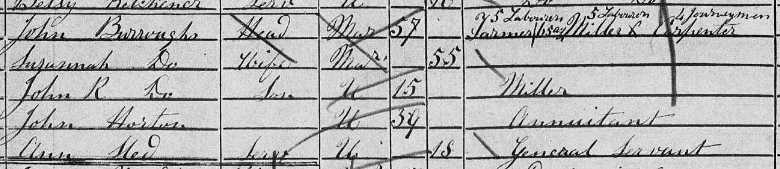
Also in the 1851 census are a Millwright Master, a Millwright Journeyman and a Millwright Apprentice.
Going back to the 1841 census there are a two journeyman millwrights, and a millwright.
By 1861 there is one millwright then in the following censuses no millwrights.
Advert
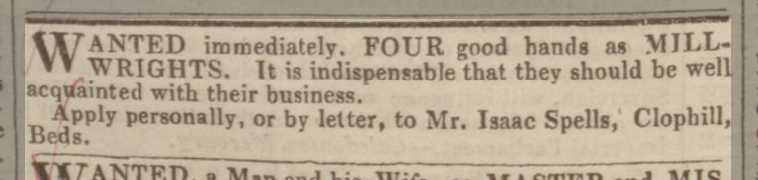
In the Northampton Mercury for 26th July 1847 is an advertisement that reads "WANTED immediately. FOUR good hands as MILLWRIGHTS. It is indispensable that they should be well acquainted with their business. Apply personally, or by letter, to Mr. Isaac Spells, Clophill, Beds." Isaac Spells was a master millwright
Stotfold Mill
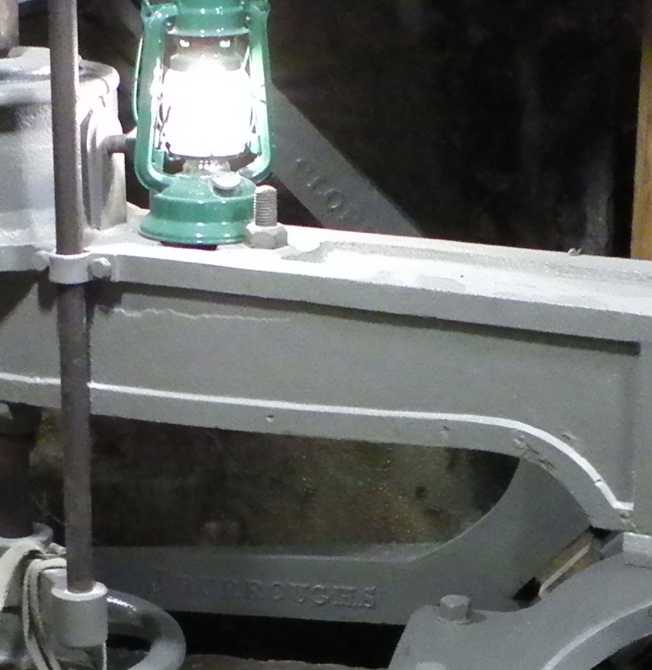
Stotfold Mill has two cast gears with J. Burroughs, Clophill" embossed on them.
Conclusion
The evidence indicates that John Burroughs, farmer and entrepreneur, owned the mill and employed staff to run it. He also had a millwrighting business that was run by Isaac Spells.
The auction description lists "valuable mill gear patterns". Were these the patterns used for casting the gears such as the ones at Stotfold Mill? Where was the iron foundry? At Clophill or maybe at a nearby town?
